Three towns, one state's rules
Corowa, Howlong and Jindera are in New South Wales, outside the City of Albury, and fall under Federation Council and Greater Hume Council. This site has not separately verified the local planning controls, heritage schedules or flood maps for any of the three, so this page does what it can do: set out the state rules that apply to every residential restump in New South Wales, explain what a restump in an older country house involves, and tell you which questions to put to your own council before anyone starts. Where the Albury pages can name a conservation area or a flood plan, this one tells you to ask. That is a limit of what has been checked, not a difference in the law.
The work itself is the same as in Albury. Restumping a house on timber stumps that have rotted or been eaten, relevelling a house whose stumps are sound, replacing bearers and joists under the wet corner, and underpinning a brick house on a strip footing that has moved. The first question is still what the house sits on, and the methods guide explains how to tell.
The NSW rules, by reference
These apply across the state and do not change between Albury and Corowa. They are set out in full on the NSW rules page; the short version is below.
| Job value (incl GST) | What NSW law requires | Source |
|---|---|---|
| Any value | Work that does not raise the house may be exempt development under the Codes SEPP; heritage items and conservation areas are excluded. The owner is responsible for checking. | NSW Planning remedial work fact sheet |
| Over $5,000 | A NSW contractor licence under the Home Building Act 1989. Restumping sits under general building work; underpinning and piering is its own category. Penalties $22,000 for an individual, $110,000 for a company. | NSW general building work licence |
| Over $5,000 | A written contract. Between $5,000 and $20,000 a small job contract. | NSW home building contracts |
| Over $20,000 | A large job contract with the 17-item checklist, and Home Building Compensation cover of at least $340,000 in place before work starts or any deposit is taken. | Service NSW, Home Building Compensation |
Two things are worth drawing out. The first is the licence check. Underpinning and piering is a licence category of its own in New South Wales, and restumping is not, so the word on the quote tells you which licence to look up on the NSW verification service. The second is the approval route. The Codes SEPP lists restumping or repairing structure foundations without increasing the height of the structure as an example of exempt development, subject to its standards: like for like, no new or resized openings, and nothing that permanently alters the load bearing capacity of the building. That exemption does not apply on a heritage item, in a heritage conservation area or on State Heritage Register land, and underpinning is not named in the policy, so whether a given underpinning job is exempt is for the engineer and the certifier or council. Raising a house is not restumping and is a planning matter wherever it happens.
What to ask your council
Because this site has not checked the Federation or Greater Hume planning controls, the questions below are the ones that decide whether the exempt route is open for a particular house. Ask the council which of the two covers your address, then ask it these, and ask for the current figure on anything with a fee attached rather than relying on a number from anywhere else.
- Is the house a listed heritage item, or inside a heritage conservation area, in the council's local environmental plan? If yes, exempt development is off the table and minor works may need an application; the council says what kind.
- Is the lot inside the flood planning area on the council's maps? Corowa and Howlong sit beside the Murray, and a restump that leaves the floor where it is is unlikely to engage flood controls, but raising the house would. Ask what the map shows for the lot.
- Does the council want to be told about exempt work? Some councils ask for nothing, some have a form. Ask.
- Does the council hold any record of past work on the house? An earlier approval or a complying development certificate for an extension tells you what the house has been through.
- Is there a council termite requirement? The NCC 2022 Housing Provisions apply termite risk management where subterranean termites present a potential risk; the council or the certifier will say whether anything local sits on top of that.
The country house on stumps
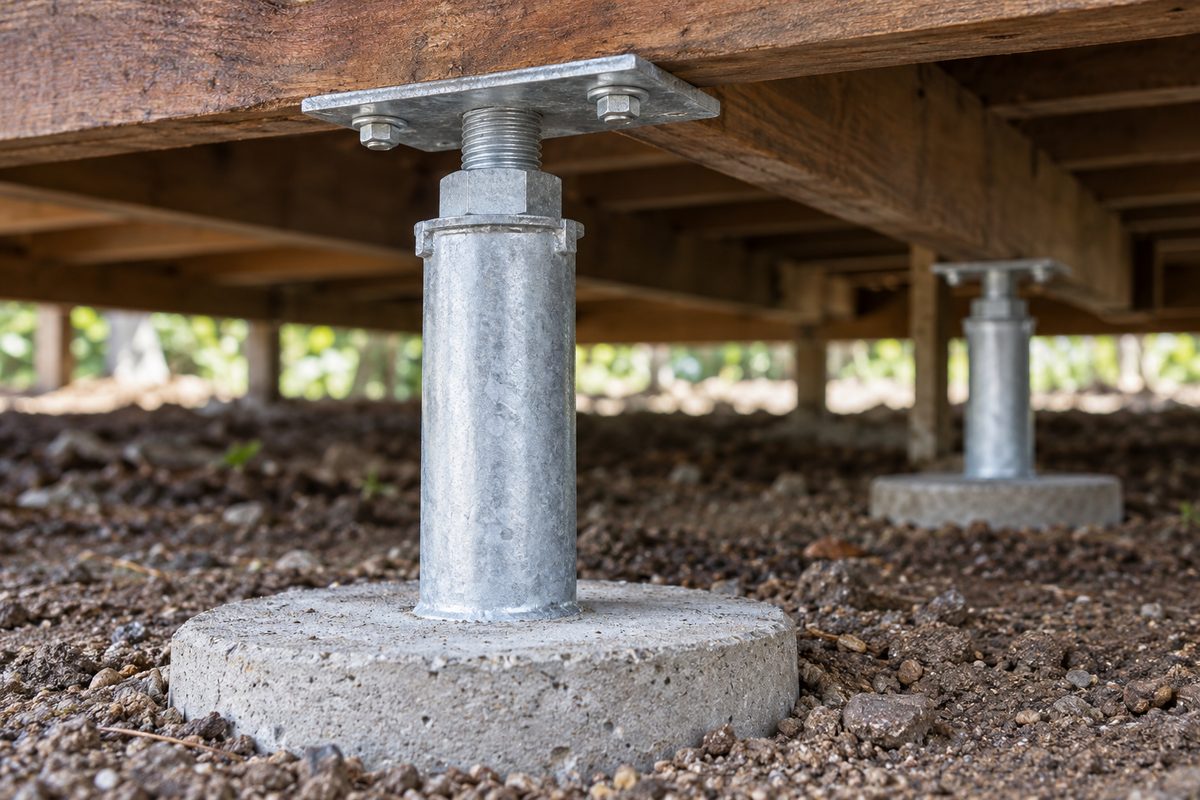
An older house in any of the three towns is likely to be weatherboard or brick on timber stumps or brick piers, and the things that have gone wrong under it are the same as under an Albury house of the same age. Timber stumps rot at the ground line where the ground holds winter water. Termites take the stumps and then the bearers. A stump that was never set deep moves with the clay. A past relevel done with stacks of packing has postponed the problem rather than fixed it. The inspection is the same hour under the floor with a torch, a probe and a level, and the quote should name the stump count, the stump type, the depth, the relevelling, a rate for bearers and joists found once the base boards are off, and the licence number. The cost guide goes through what moves the price, and the signs guide helps you look before you ring.
The ground is the one thing this page says least about, on purpose. No soil classification has been verified for any NSW-side town, so this site states none for Corowa, Howlong or Jindera; the class of a lot under AS 2870 is set by a geotechnical test. What is known is the climate at the nearest station in the research this site relies on, Albury Airport: 639.2 mm of rain a year, a mean maximum of 32.5 degrees in January, 13.3 in July and a mean minimum of 3.1 in July. Hot dry summers and cold wet winters move reactive clay and rot timber stumps wherever the two meet, and the clay guide explains the cycle. Late summer and autumn, when the holes are dry and the house is at its lowest, are the easy months for the work.
Builders from across the river
Corowa and Howlong face Victoria across the Murray, and some of the restumpers who work these towns are based on the Victorian side. A Victorian registration on its own is not a NSW licence. Under automatic mutual recognition a Victorian licence holder can work in New South Wales if the licence covers the work and they notify Building Commission NSW before starting; it applies to individual licences only, not companies. Once working in NSW the Victorian builder is bound by the NSW rules above: the contract thresholds at $5,000 and $20,000 and Home Building Compensation cover over $20,000, rather than Victoria's $10,000 contract and Home Warranty thresholds. For a home owner in Corowa the practical step is to check both registers, the NSW verification service and the Building and Plumbing Commission's practitioner register, and to ask the builder which licence the job is being done under. The border page covers the mechanics in both directions.
Jindera and the inland side
Jindera is north of Albury rather than on the river, and the floodplain question is less likely to arise, though a creek line or low ground can still hold winter water under a house. The heritage question is the same as anywhere: ask Greater Hume Council or Federation Council, whichever covers the address, whether the house is a listed item or inside a conservation area before relying on the exempt route. For a newer house on a slab, the Thurgoona page describes what footing movement looks like and why the trade is underpinning rather than stumps.
What this page cannot tell you about these three towns
It cannot name the heritage items or conservation areas in Corowa, Howlong or Jindera, because this site has not verified the Federation or Greater Hume planning schedules; the council can. It cannot say whether a lot is in a flood planning area, or quote a council fee or phone number, for the same reason. It cannot classify the ground; no soil report for the NSW side has been found and a geotechnical test is the only answer. It cannot tell you how many stumps have gone under a particular house, which is an inspection. What it can do is set out the state rules that apply regardless, and the questions that turn a general page into an answer for one address.
Check the current rules before you rely on this
This page describes restumping in Corowa, Howlong and Jindera by reference to the New South Wales rules that apply across the state, and lists what to confirm with the local council. It describes the rules in general terms as they stood in October 2026. Standards, forms, thresholds and fines change.
The authoritative sources are NSW Government, general building work licence, NSW Government, underpinning and piering work licence, NSW Government, home building contracts, Service NSW, home building compensation cover, NSW Planning, remedial building work fact sheet and NSW Government, working interstate and mutual recognition. Where anything here differs from those sources, they are right and we are not.
We are not certifiers, building surveyors, engineers, planners or lawyers. For what applies to your house, ask a licensed builder, a certifier or building surveyor, or your council (City of Wodonga on 02 6022 9300 or Albury City Council).
Accurate at the time of writing, October 2026. Always check the source before relying on it.