Reblocking is the Victorian word, and the Victorian rules come with it
On the Wodonga side of the river the trade and the council both say reblocking. The City of Wodonga's building permit table lists "Reblocking or restumping of an existing building" as work that needs a permit, using both words. The job under the floor is the one restumpers do everywhere: jack the house, replace the stumps, relevel the bearers. What is different in Victoria is everything around it. A building permit from a registered building surveyor. A builder registered with the Building and Plumbing Commission whatever the job is worth. A written major domestic building contract over $10,000. Home Warranty insurance over $20,000. None of those switch on at the same points as the New South Wales rules on the restumping Albury page, and a Wodonga owner reading an Albury quote, or the other way round, is reading the wrong rule book.
Who is allowed to reblock a Wodonga house
In Victoria the general rule is that a builder needs to be registered for domestic building work worth more than $10,000. Reblocking is one of the named exceptions. The regulator's clarification of the 2017 changes says a builder in the business of re-blocking or restumping a home (along with a short list of other work) requires registration regardless of the value of the work, and Consumer Affairs Victoria repeats it: a builder must be registered to restump or reblock a home regardless of the value. There is no small-job escape hatch for reblocking. Since 1 July 2025 the regulator has been the Building and Plumbing Commission, which replaced the Victorian Building Authority and took in dispute resolution and domestic building insurance at the same time, so older paperwork may still say VBA. The register is the Commission's find and check a practitioner service. Ask for the registration number and look it up. A New South Wales licence is not a Victorian registration, and a Wodonga job done by an Albury builder needs the steps on the border page first.
The building permit
Any building work in Victoria needs a building permit unless an exemption applies, and the Commission's practice note BP-01 sets out the exemptions. The repair, renewal and maintenance exemption applies only where the work will not adversely affect the structural soundness of the building and does not include "underpinning or replacement of footings" or "the removal or alteration of any element of the building that is contributing to the support of any other element". New stumps are new footings, so reblocking is outside the exemption, and the City of Wodonga's permit table says so in plain words. The permit comes from a registered building surveyor, who will want to know the stump type and size, the depth and the levelling method before issuing it. Other Victorian councils say the same thing in their own words: Hume states that restumping or underpinning requires a building permit, and Macedon Ranges publishes a restumping guideline asking for a registered builder, drawings of stump type, size and sole plate, and engineer's computations where required. Those are quoted here only to show it is one rule across the state; the Wodonga page is the one that applies.
Most works in Wodonga also need a Road Reserve Works Permit from the council, which matters the moment a skip, a stump delivery or a concrete truck sits on the nature strip. Owner-builders need a certificate of consent for work over $16,000, though with registration required at any value for reblocking, owner-building a reblock is not a route many people take. The council's building team is at 104 Hovell Street, Wodonga, on 02 6022 9300. The Victorian rules page goes through the permit in more detail.
Flood and heritage overlays sit on top of the permit. Wodonga is about 20 km downstream of Hume Dam, and the VICSES flood guide says most of the urban area is outside the Murray floodplain while Gateway Island is inside it; local flooding comes from Felltimber Creek, House Creek (including Huon Creek) and Jack in the Box Creek, with October 2016 the most recent event it describes. Land in the 1% AEP flood extent appears as a Land Subject to Inundation Overlay or Floodway Overlay, and a planning permit is typically needed for building on it. A reblock that puts the floor back at the same height is unlikely to trigger an overlay. Raising the house is a planning matter. Check the overlay on the planning map, or ask the council, before the surveyor is engaged.
The Victorian thresholds in one place
| Value of the job | What is required | Source |
|---|---|---|
| Any value | The builder is registered with the Building and Plumbing Commission to reblock or restump a home. The general $10,000 registration threshold does not apply to this trade. | Registration clarification |
| Any value | A building permit from a registered building surveyor, and for most works a Road Reserve Works Permit from the council. | City of Wodonga permit table |
| Over $10,000 | A written major domestic building contract under the Domestic Building Contracts Act 1995. | Consumer Affairs Victoria |
| Over $16,000 | An owner-builder needs a certificate of consent. | City of Wodonga |
| Over $20,000 | Home Warranty insurance, taken out and paid for by the builder, from 1 July 2026. Before that date domestic building insurance applied over $16,000. | Domestic building insurance |
Contract and insurance
Over $10,000 the contract has to be a written major domestic building contract, which in practice means almost every reblock. The Consumer Affairs Victoria consumer guide explains what belongs in it. The insurance changed on 1 July 2026: before that date the builder had to take out domestic building insurance where the work cost more than $16,000; from that date the builder must take out Home Warranty insurance where eligible work costs more than $20,000, the builder pays the premium, and the Commission sends the owner a notice of cover after the contract is signed. Older quotes and older web pages still say $16,000. If a quote near $20,000 does not say which side of the line it falls on and what cover comes with it, ask before signing.
Wodonga houses and Wodonga ground
Wodonga grew late and fast. Victorian Places puts the population at 3,066 in 1947, 7,789 in 1961, 18,142 in 1981 and 31,605 in 2011; the town was named a growth centre in 1973, Housing Commission estates followed, Bonegilla and Bandiana are part of the story, and Baranduda was added in 1994. In practice much of the older housing is 1960s to 1980s and commonly brick veneer, which can mean a timber floor on stumps or a slab, and the inspection has to say which before anyone quotes. The newer estates at Killara, Riverside and Silky Oaks are slab-on-ground, and their problems are slab heave and footing movement rather than stumps; that is the underpinning page, not this one.
The ground is reactive clay. Soil reports we have seen for two Wodonga-side estates classify the sites as Class M under AS 2870, one of them as M-D. The Riverside Estate report at Killara describes silty and sandy clays with expected surface movement of 20 to 40 mm and calls for stumps and piers at least 600 mm below the surface; the Silky Oaks Estate report describes sandy clays of medium to high plasticity, stumps and piers at least 500 mm down, and an allowable bearing pressure of 100 kPa from 300 mm. The class of your own site is set by a geotechnical test, not by the street, and those two reports are quoted only to show what the surveyor and the builder are working with. The clay guide explains what Class M means for a floor on stumps. Termites are the other local question: the City of Wodonga was historically listed as a termite-declared area, so confirm the current position with your building surveyor, fit ant caps on every new stump, and read the NCC Housing Provisions on termite risk management as applying wherever termites present a potential risk.
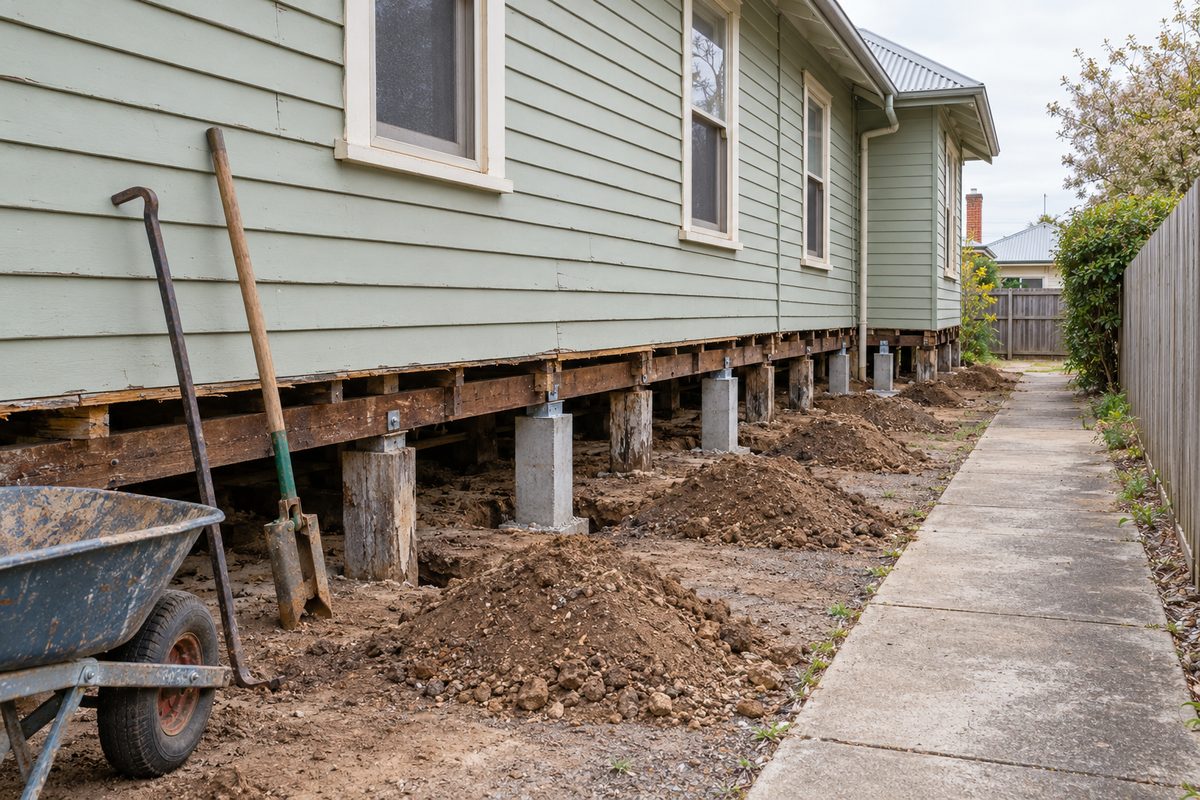
What the job looks like on a Wodonga street
- Inspection. Stumps probed, bearers sighted, levels run through the house, and a note on whether the house is on stumps throughout or has a slab section. Photographs come with the report.
- Registration checked. The builder's number is looked up on the Commission's register before anything is signed. Required at any value, so there is no job small enough to skip it.
- Surveyor engaged and permit applied for. The builder usually arranges the registered building surveyor. The surveyor checks overlays, asks for the stump details and issues the building permit. The surveyor sets the fee; ask for it in writing.
- Contract and insurance. Over $10,000 a written major domestic building contract; over $20,000 Home Warranty insurance taken out by the builder, with the notice of cover arriving from the Commission after signing.
- Road reserve permit. Where a skip or deliveries will use the nature strip, the council's Road Reserve Works Permit is in hand before the first truck.
- The work. Baseboards off, jacks under the bearers, old stumps out, new holes to the depth the surveyor and the soil call for, concrete or steel stumps set with ant caps, bearers packed to one line, vents and boards back.
- Inspections and final. The surveyor inspects at the stages set out in the permit and issues the final paperwork. Keep it with the house; the next building inspector will ask for it.
What reblocking cannot fix
Reblocking cannot stabilise a slab. Much of the newer housing at Killara, Baranduda and across the estates sits on slab-on-ground over Class M clay, and a cracking slab or strip footing is an engineer's problem and an underpinning job, not a stump job. It cannot make a wet subfloor dry; if the ground under the house holds water every winter, drainage goes in with the stumps or the new stumps stand in the same water the old ones rotted in. It cannot decide the depth of the new stumps on its own; the Wodonga estate soil reports call for 500 to 600 mm minimum on those sites, and the surveyor and builder settle the figure for yours. And it cannot tell you whether an overlay applies to your block. The planning map and the council do that.
Check the current rules before you rely on this
This page describes how reblocking is permitted, registered, contracted and insured on the Wodonga side of the border. It describes the rules in general terms as they stood in October 2026. Standards, forms, thresholds and fines change.
The authoritative sources are Building and Plumbing Commission, practice note BP-01, when is a building permit required, City of Wodonga, do I need a building permit, Victorian Building Authority, clarification of registration requirements for domestic builders, Consumer Affairs Victoria, preparing a major domestic building contract, Building and Plumbing Commission, domestic building insurance and Building and Plumbing Commission, find and check a practitioner. Where anything here differs from those sources, they are right and we are not.
We are not certifiers, building surveyors, engineers, planners or lawyers. For what applies to your house, ask a licensed builder, a certifier or building surveyor, or your council (City of Wodonga on 02 6022 9300 or Albury City Council).
Accurate at the time of writing, October 2026. Always check the source before relying on it.